How to identify Rowan
Sorbus aucuparia
Rowan berries are relished especially by thrushes and other bigger songbirds. One bird that is very fond of them is the waxwing (Bombycilla garrulus).
It breeds in Scandinavia but, if rowan berries become scarce in its homeland in winter, it comes in large flocks to the UK and Ireland to feed on Rowan and some other, especially red, fruits. It can eat two or three times its own body weight in a day.
Aucuparia means “bird-catching”. Rowan was used in the past to create birdlime used in the unfortunate practise of trapping songbirds for food.
Rowan berries are relished especially by thrushes and other bigger songbirds. One bird that is very fond of them is the waxwing (Bombycilla garrulus). It breeds in Scandinavia but, if rowan berries become scarce in its homeland in winter, it comes in large flocks to the UK and Ireland to feed on Rowan and some other, especially red, fruits. It can eat two or three times its own body weight in a day.
Shield-bugs relish its berries as well. They are even edible to humans, are rich in vitamin C, but people should be careful of eating it raw in large quantities as it contains parasorbic acid, which is slightly toxic, but breaks down into non-poisonous compound when cooked.

Rowan is a deciduous tree. It is very frost-hardy, wind-resistant and has deep roots, so can grow even in rocky crevices. It tolerates poor, thin, acid soil.
Rowan also colonizes bare ground together with birch and grows at a higher altitude than most other deciduous trees. Unlike downy birch, it doesn’t form woodlands on its own and can’t tolerate waterlogged sites.

Key facts about Rowan, Mountain Ash
Common name(s)
Rowan, Mountain Ash
Scientific name
Sorbus aucuparia
Common family name
Rose
Scientific family name
Rosaceae
- How to grow Rowan
Where does grow?
Lorem ipsum dolor sit amet, consectetur adipiscing elit, sed do eiusmod tempor.
- W7 Alder-ash woodland with yellow pimpernel
- W8 Lowland mixed broadleaved woodland with dog’s mercury
- W9 Upland mixed broadleaved woodland with dog’s mercury
- W10 Lowland mixed broadleaved woodland with bluebell
- W11 Upland oak-birch woodland with bluebell
- W14 Beech-oak woodland with bramble
- W15 Beech-oak woodland with wavy hair-grass
- W16 Lowland oak-birch woodland with bilberry
- W17 Upland oak-birch woodland with bilberry
- W18 Scots pine woodland with heather
- W19 Juniper woodland with wood sorrel
- Edge plants suitable for open woods, woodland edges or hedges
- Plants for shrub layer under high forest trees
Characteristics of Rowan, Mountain Ash
The following characteristics give us all the clues we need to identify a Rowan, Mountain Ash.
Leaves
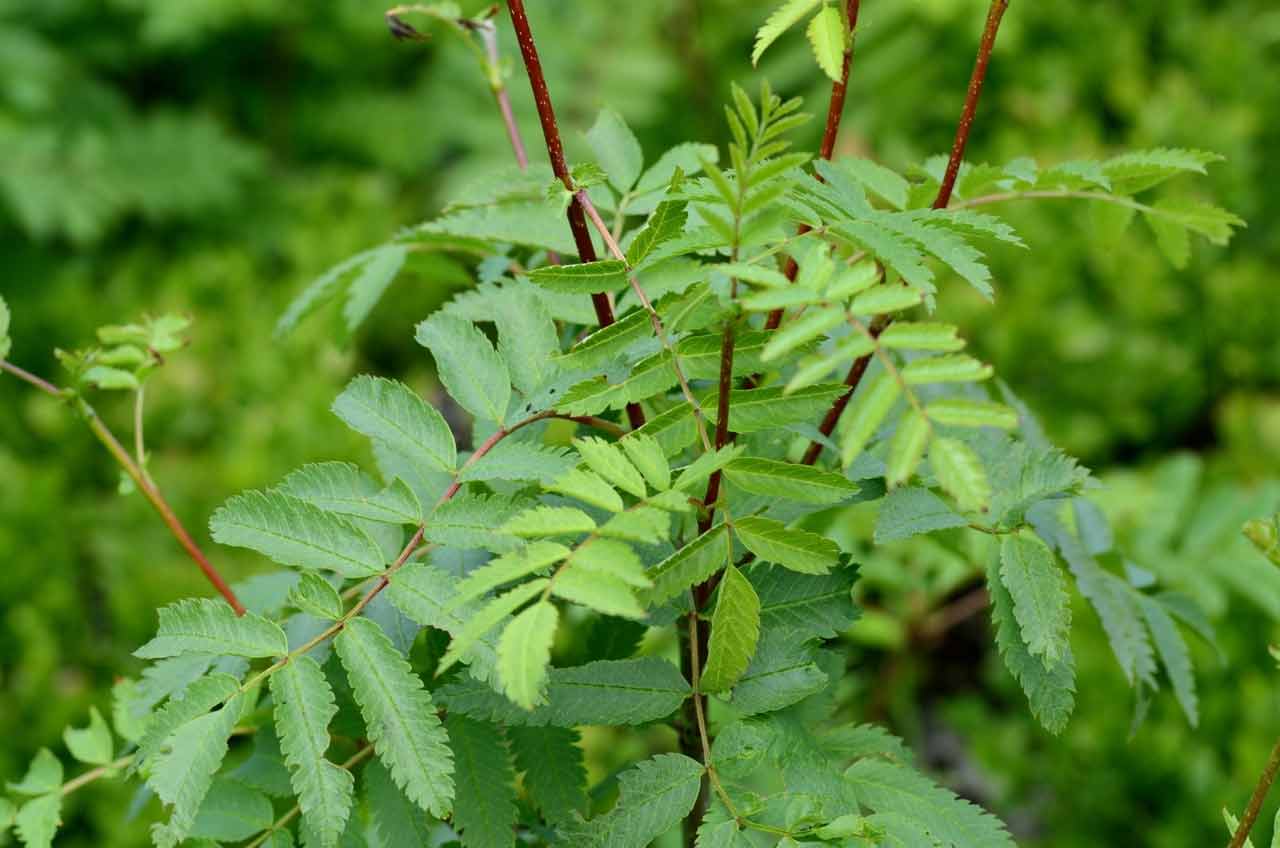
Leaves are composed of 6-8 pairs of small leaflets, each 3-6 cm long and toothed at the edges.
They are usually hairless, dark green above and grey-green below. The leaflet at the tip is never larger than the rest. The leaves turn yellow and red in autumn and often stay on the tree into November.
Flowers

Flower heads are creamy white. Each flower has 5 petals – like the flowers of other members of the rose family. They are arranged in flat, branched clusters about 10cm wide, usually.
The flowers appear from May to June. They have a very distinct smell that attracts flies, beetles and bees. These help to transfer the pollen from one flower to another.
Fruit
Fruits are almost round, fleshy red berries, up to 10mm across. They are orange at first, with yellow flesh.
They ripen in September and each has between 2 and 8 seeds (usually 3 or 4). Each fruit has a tiny “star” in the middle which is a remnant of the calyx and reminds us, that it belongs to the same family as dog rose.
Seeds are dispersed by birds, that’s why we sometimes find so-called “flying rowans” in unreachable places, eg. in the crown of another tree, like oak.
Bark

The bark is smooth, shiny and grey. Winter twigs are grey with hairy buds (especially when young). The wood is dense, hard and pale brown. It is used for turnery, carving and is good for firewood.
Together with Yew, it was used in the Middle Ages for making bows.