How to identify Silver Birch
Betula pendula
Silver birch is a pioneer tree. That means it is one of the first trees to colonise new (or cleared) land.
It grows widely across the UK preferring a drier, sandier soil then downy birch. This often means downy birch is the more common birch in Ireland and Scotland and at higher altitudes.

Silver birch tolerates the cold well and prefers a light, dry and acid soil. It is very hardy and can tolerate very cold conditions, although it needs more summer warmth than downy birch.
Silver birch grows in woods and on heathland.
Key facts about Silver Birch
Common name(s)
Silver Birch
Scientific name
Betula pendula
Common family name
Birch
Scientific family name
Betulaceae
- How to grow Silver Birch
Where does grow?
Lorem ipsum dolor sit amet, consectetur adipiscing elit, sed do eiusmod tempor.
- W8 Lowland mixed broadleaved woodland with dog’s mercury
- W9 Upland mixed broadleaved woodland with dog’s mercury
- W10 Lowland mixed broadleaved woodland with bluebell
- W11 Upland oak-birch woodland with bluebell
- W12 Beech-ash woodland with dog’s mercury
- W14 Beech-oak woodland with bramble
- W15 Beech-oak woodland with wavy hair-grass
- W16 Lowland oak-birch woodland with bilberry
- W17 Upland oak-birch woodland with bilberry
- W18 Scots pine woodland with heather
- Minor forest tree
- Edge plants suitable for open woods, woodland edges or hedges
Characteristics of Silver Birch
The following characteristics give us all the clues we need to identify a Silver Birch.
Leaves

The silver birch has pointed, trian
Silver birch has both male and female flowers (catkins) on the same tree.
The male catkins are formed in the autumn and will remain on the tree all winter – only opening in April or May. The female catkins appear in spring with the new shoots.
gular leaves. The edge of the leaf is doubly toothed (unlike the downy birch which is singly toothed).
Flowers

Silver birch has both male and female flowers (catkins) on the same tree.
The male catkins are formed in the autumn and will remain on the tree all winter – only opening in April or May. The female catkins appear in spring with the new shoots.
Fruit

The seeds are dispersed by the wind. They are tiny nutlets (only 2-3mm across) with two wings, helping them to travel up to one mile from the parent tree.
The female catkins, where the seeds develop, eventually disintegrate in September and October, releasing the seeds. One tree can produce many thousands of seeds each year.
Bark

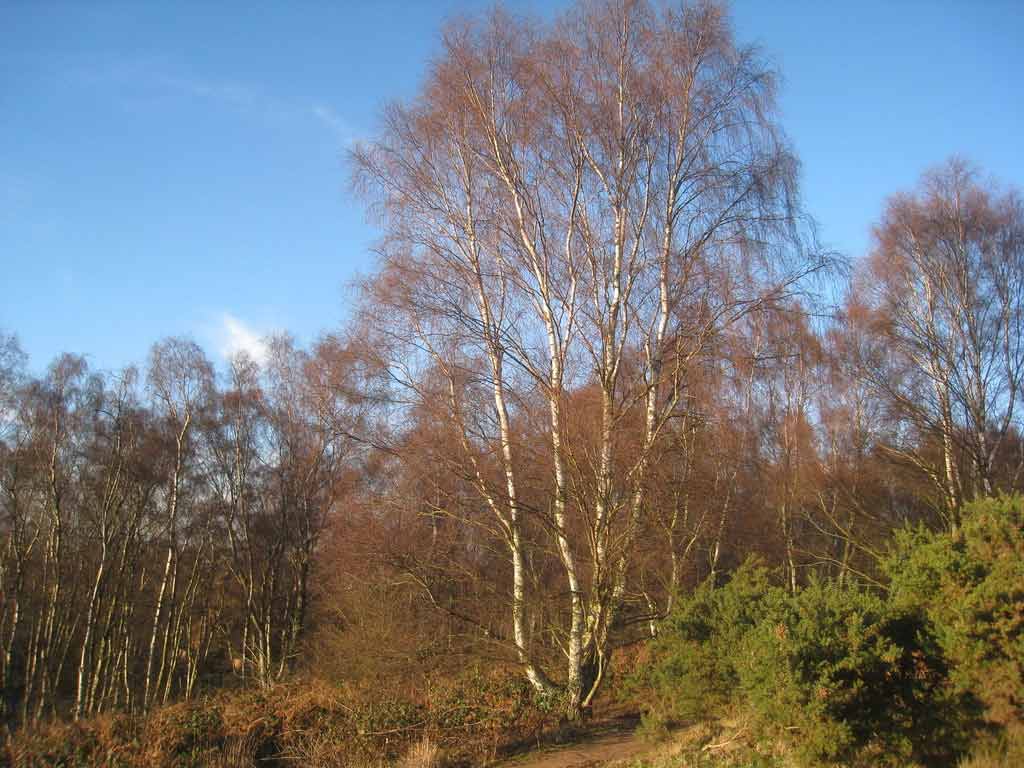
The bark is whiter than downy birch with scattered black fissures. The young twigs are typically covered in white ‘warts’, and feel rough to the touch. The bark becomes much more rugged with diamond-shaped crevices as it gets older.